
Robot Vacuum CleanerBattery & Docking Connectors
Engineered for 14.4V / 16.8V 4S lithium packs and auto-empty charging docks. For main power discharge and BMS signals, select our 11PIN hybrid connector (25A continuous / 30A momentary); for compact packs, choose 2.5 mm blade pairs; for auto-docking pads, verify wiping contact travel and wear-resistant gold plating.
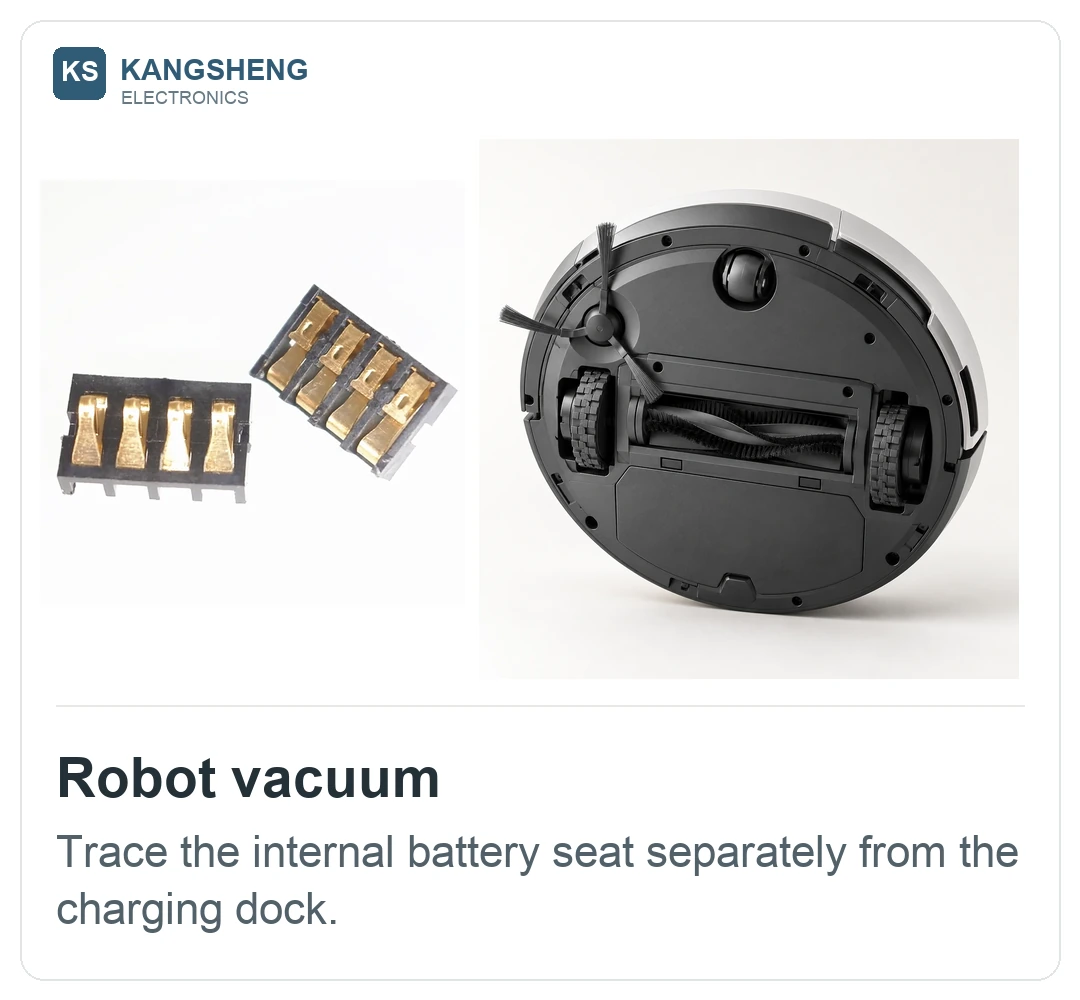
Two System Architectures: Internal Pack vs. External Dock
A robot vacuum contains two distinct electrical connection systems: the internal traction battery connection to the mainboard, and the external floating interface between the chassis and the charging station.
- 01
Internal Enclosed vs. External Open Interfaces
The internal pack sits in an enclosed bay facing motor vibration and I²R thermal rise. The external docking interface is a blind-mate system that must tolerate positional variation, dust, and carpet fibers.
- 02
Main Power Discharge & Multi-Signal Integration
4S packs draw 10A-15A peak during carpet boost or motor stalls, while requiring NTC sensing and BMS communication. The 11PIN hybrid connector combines 4 power pins and 7 signal pins in a single compact footprint.
- 03
Auto-Docking Alignment & Anti-Arcing Hard Gold
IR/LiDAR docking has ±2mm-±5mm lateral variation. Charging electrodes need generous lead-in chamfers, ≥1.0N normal force to penetrate dust films, and 3u"-5u" hard gold plating to eliminate contact arcing.
Two Critical Connection Points
Directly compare the actual connectors at critical equipment points. All parts are produced on Kangsheng in-house tooling.
4S Lithium Battery Pack Interface
High-current & multi-signal battery-to-board path
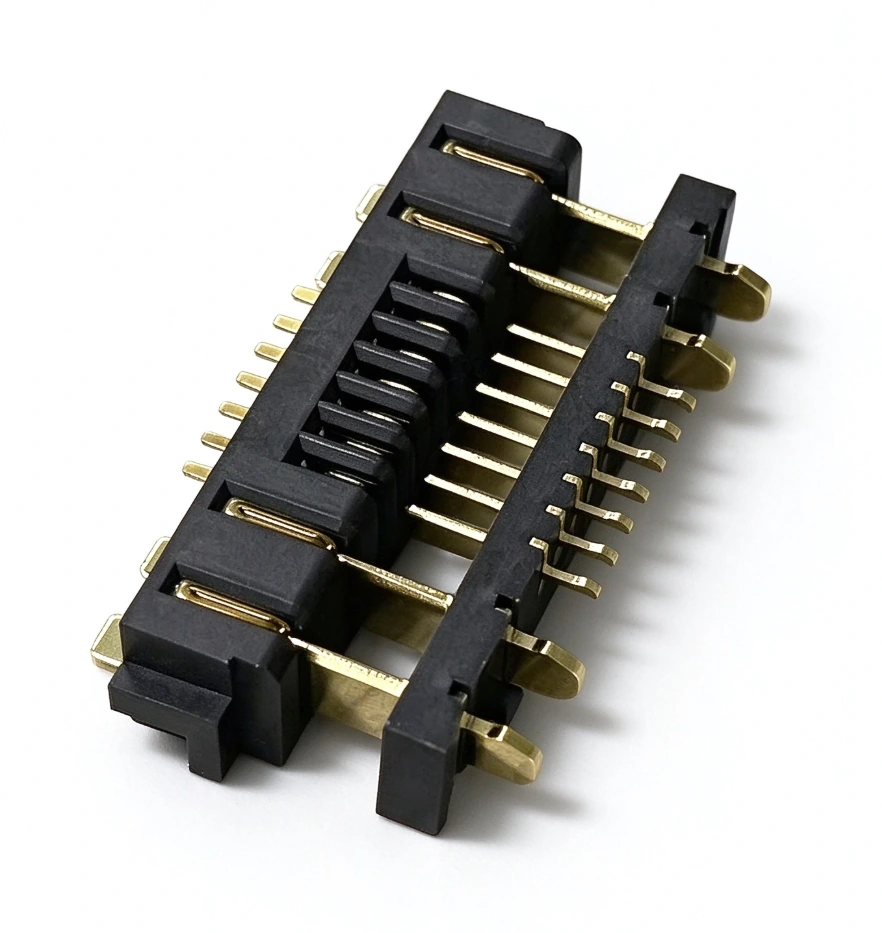
Robot vacuums typically run on 4S lithium-ion packs (14.4V nominal, 16.8V peak). Max suction and obstacle climbing surge currents above 10A, requiring simultaneous NTC sensing and BMS communication. The 11PIN hybrid connector merges high-current power (25A rated) with 7 signal lines in one compact footprint.
Auto-Empty Docking Station Contacts
Repeat auto-docking friction & anti-arcing contacts
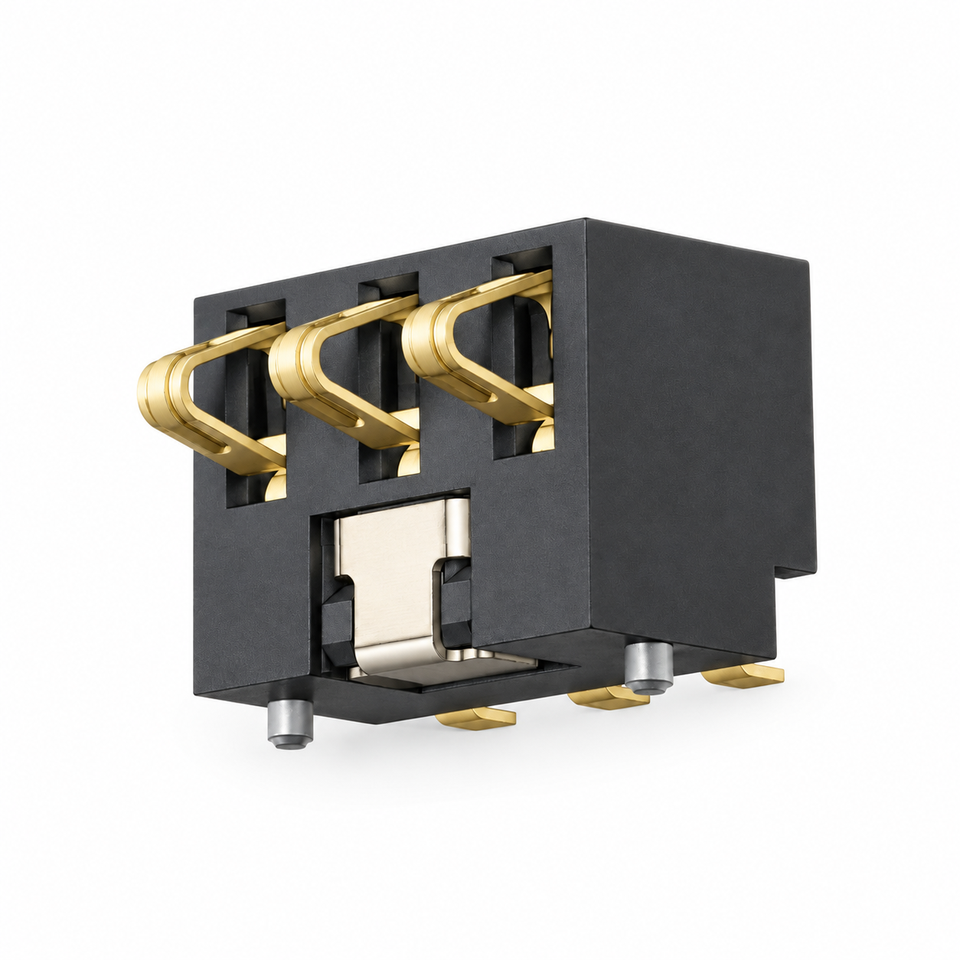
Auto-docking relies on wheel drives, introducing millimeter-level alignment tolerances. Docking electrodes face dust and carpet fibers, requiring sufficient normal force (≥1.0N) to wipe away surface oxide/dust and 3u"-5u" hard gold plating to prevent contact arcing.
Drawing-Backed Connector Comparison
The table lists 5 core starting models for internal battery and charging dock interfaces. Values are taken directly from standard drawing ratings, with 2D PDF and 3D models available.
| Application / Task | Model & Form | Ratings & Mounting Check | Source Files |
|---|---|---|---|
| Internal main battery: 4 power + 7 signal pins | KS-HC-11M / KS-HC-11F11-pin hybrid · 2.0 / 5.0 mm mixed pitch · 38.7 × 7.67 mm | 25 A rated, 30 A momentary on power pins; PA9T resinPower pins for main drive & charging, central pins for NTC & SMBus; 180°/90° mounting. | KS-HC-11M / KS-HC-11F PDF ↗KS-HC-11M / KS-HC-11F CAD / 3D ↗ |
| Compact pack female: right-angle through-hole | KS-BL-352 · 4P4-contact · 2.50 mm pitch · right-angle mating | 7 A continuous, 10 A momentaryMates with vertical or right-angle male blades; 500V withstand, suitable for 4S packs. | KS-BL-352 · 4P PDF ↗ |
| Board male blade: vertical SMT with posts | KS-2.5-M-VSMTPOST4-position · 2.50 mm pitch · 0.60 mm blade thickness | 5 A / 30 V ACLocating posts resist shear; check mating depth and PCB clearance. | KS-2.5-M-VSMTPOST PDF ↗ |
| Side-docking or side-press contacts: shear resistant | KS-BC-75-3PD5403 contacts · 2.50 mm pitch · 5.4 mm housing | 2.0 A / 12 V (signal / auxiliary net)Nominal compression 1.35 mm; suitable for docking detection and guide contacts. | KS-BC-75-3PD540 PDF ↗KS-BC-75-3PD540 CAD / 3D ↗ |
| Top-press compression: ultra-thin 3.0 mm housing | KS-BC-82-4PD3004 contacts · 2.50 mm pitch · 3.00 mm housing | 2.0 A / 12 VFree projection 1.75 ± 0.2 mm; set loaded working position via assembly drawing. | KS-BC-82-4PD300 PDF ↗KS-BC-82-4PD300 CAD / 3D ↗ |
Verify blade thickness, mating engagement depth, temperature rise (ΔT < 30K) and housing resin grade (PA9T/LCP).
Electrical Duty: Continuous Discharge vs. Fast Charging
Lithium discharge duty and docking recharge represent distinct thermal rise profiles. Always evaluate continuous current, peak surge and contact resistance independently.
4S Li-ion Battery Discharge Profile
4S Lithium Discharge: Brushless vacuum motors and drive wheels draw 30W–50W (approx. 2A–3.5A) in normal cleaning. When boosting on carpets or clearing jams, peak currents surge to 10A–15A for several seconds. Connectors must withstand 15A transient spikes without exceeding 30K thermal rise.
Fast Charging Input & Heat Prevention
Fast Charging Input: Modern all-in-one stations support 1C–2C charging with currents of 2A–4A. Contact resistance above 50mΩ can generate several watts of local heat, risking housing softening. Kangsheng uses C5191 phosphor bronze to maintain contact resistance below 20mΩ.
Frequently Asked Engineering Questions
Compiled from frequent engineering enquiries from robot vacuum OEMs, ODMs and brand technical teams.
Can a connector marked DC12V be used with a 16.8V 4S lithium pack?
The 12V rating on drawings is a standard electrical test condition, not a dielectric limit. Kangsheng 11PIN and blade connectors feature dielectric withstand voltages exceeding AC 500V with ample creepage for 16.8V systems.
How should the KS-HC-11M male and KS-HC-11F female be configured?
Typically, the female receptacle (KS-HC-11F) is mounted on the vacuum mainboard (recessed to prevent shorting), while the male header (KS-HC-11M) is attached to the battery pack. Available in 180° and 90° solder orientations.
How do docking contacts prevent arcing and blackening oxidation?
Two critical steps: ensure mechanical contacts close before the charging controller ramps current (BMS soft-start), and use ≥3u" hard gold plating with ≥1.0N normal force to penetrate surface oxide films.
Is there a more compact alternative if pack space is extremely limited?
If fewer signal nets are required, our KS-BL-352 4-contact blade female paired with the KS-2.5-M-VSMTPOST male (2.5mm pitch) occupies only 12mm in length, accommodating power ±, NTC, and one data line.
Do you support custom tooling or housing height adjustments?
Kangsheng operates in-house stamping and injection tooling facilities. Adjusting housing height or locating posts on existing contacts takes 3–5 days for samples; new tooling takes 20–25 days for T1 samples.
What Kangsheng Provides
01 / In-House Tooling
In-house tooling: KS-HC-11M/F and blade connectors produced on proprietary dies.
02 / Source Drawings
Immediate drawings: 2D PDF tolerance drawings and 3D STEP/DWG models ready to download.
03 / Free Engineering Samples
Free sampling: 3–5 day turnaround for robot vacuum engineering sample verification.
Send Your Robot Vacuum Drawings. 24h Engineering Review.
Share your pack voltage, continuous/peak current, BMS signal count and available envelope. Send your PCB footprint or CAD section, and our engineering team will provide selection guidance and free samples.
Or email engineering directly: sales@kangshengelec.com