
ASSEMBLY & SELECTION GUIDE
C&K and ALPS Alpine Slide Switch Replacement Guide: Matching Pitch, Actuator Height, and Contact Timing (SPDT/DPDT)
A definitive engineering cross-reference guide for replacing C&K (JS/PCM/OS series) and ALPS Alpine (SSSS/SSSU/SSAJ series) miniature slide switches: resolving BBM vs MBB contact timing, terminal pitch alignment (1.27/2.0/2.54mm), actuator height and travel tolerances, and flux-creepage prevention under lead-free reflow.
In portable medical devices, industrial wireless communication handsets, high-fidelity audio equipment, surveillance security cameras, and test instrumentation, miniature slide switches from C&K (now Littelfuse) — including the JS, PCM, OS, and AYZ series — and ALPS Alpine (SSSS, SSSU, SSAJ series) have long served as baseline BOM selections.
However, extended lead times on legacy imports (often spanning 26 to 40 weeks), rising unit costs, and sudden End-of-Life (EOL) notices have created an urgent imperative for hardware engineering and procurement teams to qualify reliable, domestic drop-in replacements.
While functionally straightforward, replacing a slide switch involves critical mechanical, kinematic, and electrical nuances. Based on real-world volume manufacturing and qualification test data for KS-SS-042 (MSK-23D18), KS-SS-020 (MSK-01Q/MSS-23C02), KS-SS-006, and KS-SS-012, Kangsheng Electronics engineering team details the essential cross-reference verification methodology below.
1. Contact Timing: Break-Before-Make (BBM) vs. Make-Before-Break (MBB)
The most destructive parameter overlooked during component cross-referencing is contact switching timing:
1.1 Break-Before-Make (BBM / Non-Shorting)
- Kinematic Profile: As the actuator slides from Position 1 to Position 2, the movable contact blade completely breaks connection with the Position 1 terminal and enters a transient open floating state before establishing contact with Position 2.
- Typical Circuits: Selecting between independent power rails (e.g., switching between 5V USB and 3.7V Li-ion battery rail), digital logic state selection.
- Cross-Reference Hazard: Accidentally specifying an MBB switch on a dual-rail power circuit bridges the two power supplies together during the travel transition, destroying protection diodes or triggering battery protection latch-off.
1.2 Make-Before-Break (MBB / Shorting)
- Kinematic Profile: The movable contact blade establishes contact with the Position 2 terminal prior to releasing from the Position 1 terminal, resulting in a brief microsecond electrical overlap.
- Typical Circuits: Audio gain stepping networks, RF antenna selection paths, or circuits requiring non-floating inputs to suppress voltage transients.
- Cross-Reference Hazard: Inserting a BBM switch into an audio pre-amplifier introduces an open-circuit state mid-stroke, inducing severe speaker pop noise and potential transient amplifier clipping.
Kangsheng Engineering Guideline: Inspect the original C&K or ALPS part number suffix rigorously (e.g., C&KNindicates Non-shorting;Sindicates Shorting). Standard Kangsheng models like KS-SS-042 (MSK-23D18) feature high-reliability Non-Shorting (BBM) architecture with transient break intervals held between and .
2. Mechanical Envelope: Pitch, Actuator Height, Travel, and Locating Pegs
Slide switches interact directly with physical enclosure apertures. PCB footprint tolerances must align to micron-level precision:
2.1 Terminal Pitch and Footprint Geometry
- Pitch Categories: Sub-miniature packages utilize or ; standard precision SMT packages use or ;
- Poles and Throws: Single Pole Double Throw (SPDT / 1P2T, 3 pins), Double Pole Double Throw (DPDT / 2P2T, 6 pins), or Double Pole Three Throw (DP3T, 8 pins).
- Locating Bosses (Pegs): Verify whether your PCB layout features alignment peg holes. ALPS SSSS9 series offers variants with no pegs, single pegs, or dual pegs. Kangsheng KS-SS-020 provides standardized JEDEC compliant SMT pads with integrated mechanical locating posts to maximize solder joint shear strength.
2.2 Actuator Height and Operating Stroke (Travel)
- **Height () Measurement Baseline**: Is the actuator height referenced from the top of the PCB surface or from the switch housing top? C&K datasheets commonly reference height from the top of the metallic/thermoplastic switch body ().
- Travel Stroke: Typical travel spans or . If a replacement unit has shorter travel, enclosure bezel guide slots may bottom out prematurely, leaving internal contacts partially unseated. Conversely, excessive travel will bind against enclosure cutouts.
- Operating Force: Kangsheng slide switches maintain actuation force tolerances at , ensuring crisp detent retention without accidental sliding.
3. Contact Physics: Dry-Circuit Performance and Contact Resistance Stability
In modern handheld electronics, slide switches frequently route low-voltage, micro-ampere () logic signals under dry-circuit conditions:
3.1 Silver (Ag) vs. Gold (Au) Contact Metallization
- Silver-Plated (Option Q): Suited for power paths switching , yielding initial contact resistance . However, in humid or trace sulfur () environments, silver forms a non-conductive silver sulfide film.
- Gold-Plated (Option G): Contact areas feature pure gold over nickel barrier. Gold remains inert against environmental oxidation, making it mandatory for dry-circuit signals (). Kangsheng supports selective gold plating across its full slide switch portfolio.
3.2 Contact Resistance Degradation Under Cycling
While low-cost switches quote un-energized mechanical endurance, contact wipe and electrical arcing erode the conductive interface. Kangsheng sliding contact assemblies utilize precision-stamped phosphor bronze springs that maintain contact resistance after 10,000 full rated cycles (far exceeding the industry failure limit).
4. Cross-Reference Replacement Matrix: C&K, ALPS Alpine & Kangsheng
| Competitor P/N | Poles & Throws / Pins | Terminal Pitch | Actuator Height | Contact Timing | Kangsheng Replacement | CAD & Specification |
|---|---|---|---|---|---|---|
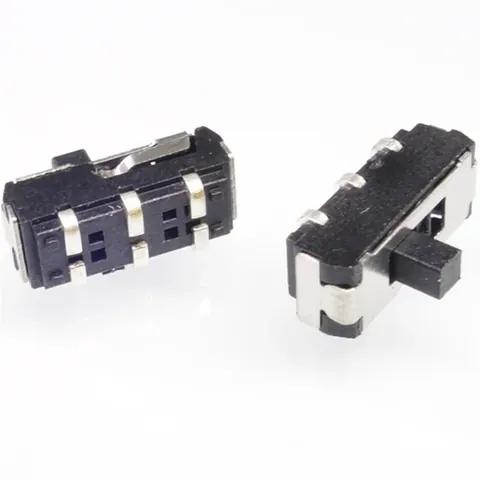
| C&K JS202011SCQN | DPDT (2P2T) 6-Pin | 2.0 mm SMT | 2.0 mm Side slide | BBM (Non-Shorting) | KS-SS-042 (MSK-23D18) | Request PDF · Request STEP |
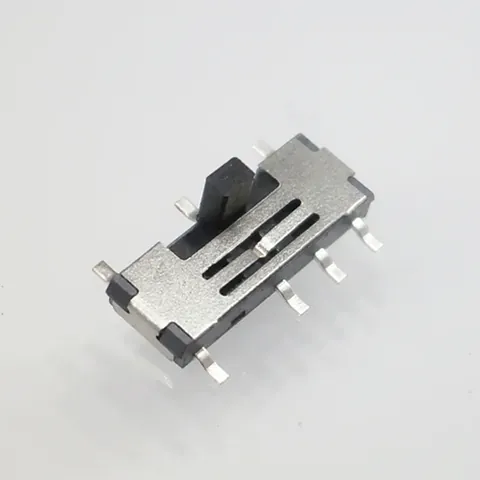
| C&K PCM12SMTR | SPDT (1P2T) 3-Pin | 2.54 mm SMT | 1.4 mm Top slide | BBM (Non-Shorting) | KS-SS-020 (MSK-01Q) | Request PDF · Request STEP |
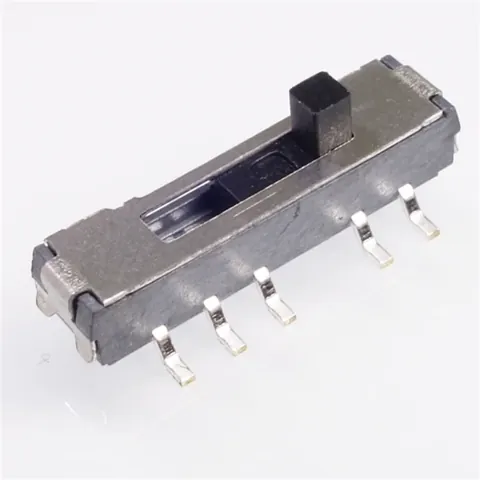
| ALPS SSSS912100 | SPDT (1P2T) 3-Pin | 2.0 mm SMT | 2.0 mm Side slide | BBM (Non-Shorting) | KS-SS-006 | Request PDF · Request STEP |
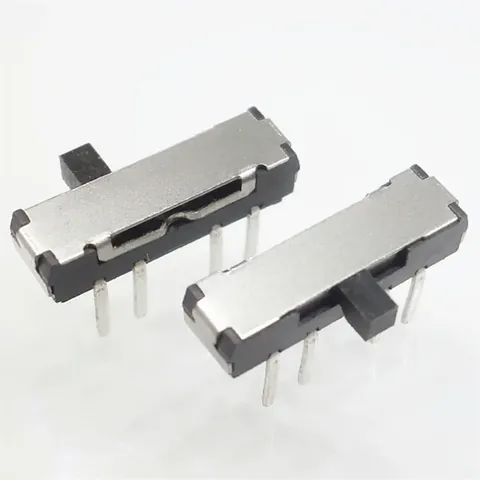
| ALPS SSSU011700 | SPDT (1P2T) 3-Pin | 2.54 mm DIP | 4.0 mm Vertical TH | BBM (Non-Shorting) | KS-SS-012 | Request PDF · Request STEP |
5. DFM Best Practices: Preventing Reflow Flux Creepage
During SMT reflow soldering (peak ), the most prevalent failure mode in sub-miniature slide switches is flux wicking and actuator seizure:
- Mechanism: Molten rosin flux wicks up terminal leads via capillary action, penetrating into the slide cavity. Upon cooling, polymerized flux binds the slider solid or insulates contact surfaces.
- Kangsheng Engineering Countermeasures:
- Insert Molding: Terminal contacts are molded directly into high-temperature LCP housings under multi-cavity high-pressure injection, eliminating microscopic capillary voids along lead frames;
- Ultrasonic Barrier Grooves: Internal relief reservoirs capture trace volatile vapors, preventing liquid flux condensation on active sliding wiping paths.
6. Engineering FAQs
Q1: Is a PCB layout re-spin necessary when replacing C&K or ALPS with Kangsheng?
A: In virtually all standard instances, Kangsheng cross-reference switches are 100% pin-compatible form-fit-function drop-in replacements. Obtain the STEP file for the selected full part number before checking assembly clearance: Request STEP. Download a listed file, or request an unlisted file and ask for the specific variant and revision in the reply. Once received, use the matching file in Altium Designer, KiCad, or OrCAD for the clearance check.
Q2: Are Kangsheng slide switches rated for lead-free SMT reflow profiles?
A: Yes. All Kangsheng SMT slide switches utilize modified Liquid Crystal Polymer (LCP) capable of withstanding peak reflow temperatures of for per J-STD-020E without housing warpage, blistering, or actuator friction changes.
Q3: What is the sample availability and qualification turnaround time?
A: For evaluation samples, inspection reports and 2D PDF drawings, provide the full part number and quantity when you request drawings. The reply should identify the available documents and sample timing.
CATALOGUE REFERENCES
Related products
YOUR NEXT DESIGN CHECK
Send us your drawing.
We’ll check pitch, height and compression against your assembly requirements.
Ask about this article