
ASSEMBLY & SELECTION GUIDE
Micro Switch (Snap-Action) Over-Travel, Operating Force Tolerances, and Dust/Oil Ingress Protection: Industrial Selection Guide
Comprehensive engineering guide on snap-action micro switches: over-center snap mechanics (FP/OP/PT/OT/MD travel model), over-travel (OT) housing fracture prevention, bounce suppression (≤1.5ms), AgSnO2 anti-welding contacts, and roller/plunger actuator selection.
In industrial automation lines, CNC machine over-travel limits, autonomous mobile robot (AMR) bump strips, commercial appliances, and high-reliability medical diagnostic equipment, Micro Switches (Snap-Action Switches, such as industrial KW3 series and subminiature MX series) are indispensable. Leveraging precision over-center spring mechanisms, they deliver the unique ability to execute sub-millisecond snap-action contact transfers from micro-scale mechanical displacements, completely independent of operator actuation speed.
However, mechanical packaging and hardware engineers frequently encounter three catastrophic field failure modes:
- Operating & Release Force Drift (Boundary Chattering): When external cams or actuator levers deliver forces right on the edge of the rated Operating Force (OF), the switch hesitates at its geometric dead center, inducing sustained contact chatter, contact bounce, and false PLC trigger events;
- Insufficient Over-Travel & Housing Fracture: Following contact transfer, switches require sufficient safety Over-Travel (OT). If driving actuators compress plungers rigidly against internal mechanical stops, cyclic kinetic shocks shatter thermoplastic housings and alignment pins within thousands of strokes;
- Airborne Mist Contamination & Contact Passivation: Operating in dusty machine shops or near cutting fluids, non-sealed switch cavities ingest oil aerosols and metal fines. Airborne organics undergo carbon arc pyrolyzation, encapsulating silver alloy contacts in non-conductive soot.
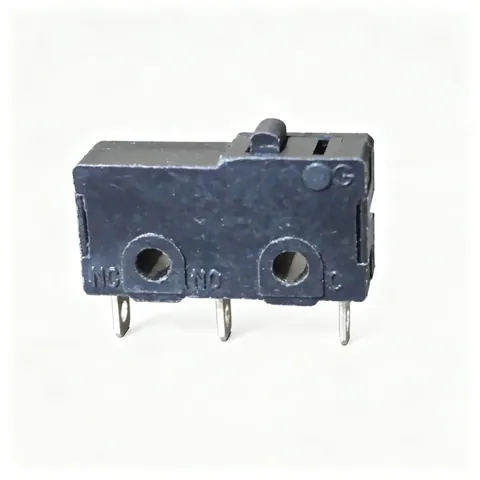
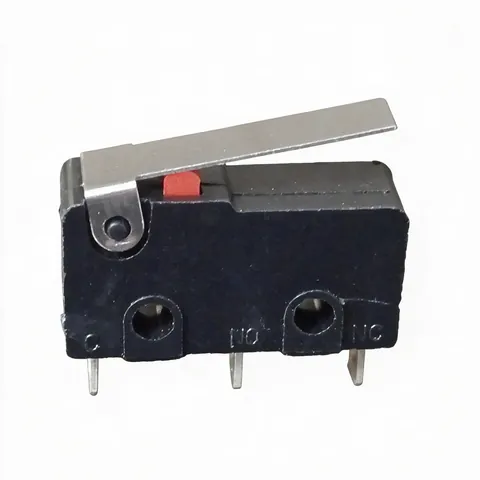
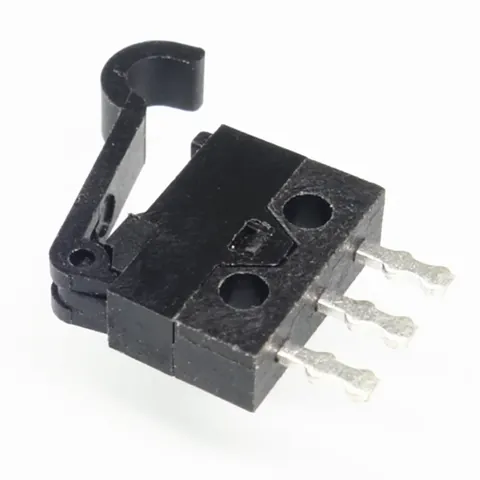
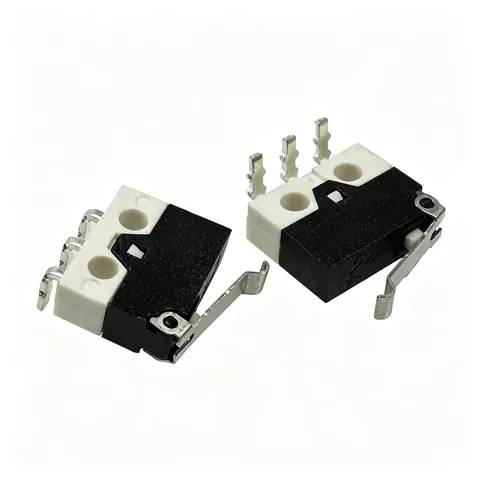
Synthesizing mechanical cycle endurance profiles and electrical contact thermal data across Kangsheng's industrial snap-action lineup—including the KS-微动-010 Pin Plunger Switch, KS-微动-011 Straight Lever Switch, KS-微动-005 Roller Lever Switch, KS-微动-004 Compact Lever Switch, and KS-微动-001 Subminiature Snap Switch—our engineering group analyzes force-deflection travel curves, anti-chatter spring dynamics, and ingress-protected selection rules.
1. Snap-Action Physics: Force-Deflection Mechanics and 5 Core Travel Parameters
The hallmark of a snap-action switch is its over-center spring geometry. As external actuator motion pushes internal beryllium copper spring leaves past a geometric tipping plane, mobile contacts transfer between Normally-Closed (NC) and Normally-Open (NO) states within microseconds at speeds exceeding 1 meter per second.
1.1 Core Mechanical Parameters Defined
When reviewing Kangsheng 2D mechanical specifications, engineers must confirm five critical travel dimensions:
- Free Position (FP): The initial distance from the actuator tip to the mounting hole centerline under zero applied load;
- Operating Position (OP): The precise dimensional height where snap transfer occurs. Tolerances are held strictly within ****;
- Pre-Travel (PT): The travel distance traversed from Free Position to Operating Position ();
- Over-Travel (OT, Crucial Safety Parameter): The allowable displacement past the Operating Position. **Golden Engineering Rule: Calibrate driving cams so steady-state engagement settles within to of nominal OT**. Never bottom out plungers against internal housing stops;
- Movement Differential (MD): The hysteresis displacement required between forward actuation (OP) and return reset (RP). Smaller MD increases sensitivity but compromises shock immunity.
1.2 Operating Force (OF) and Release Force (RF) Margins
- Operating Force (OF): Peak force required to trip the over-center mechanism ( for subminiature MX series; for heavy-duty KW3 series);
- Release Force (RF): The spring-driven return force as the actuator retracts. Residual friction in external linkages must remain below 50% of nominal RF to prevent switch jamming.
2. Contact Metallurgy: Anti-Chatter Spring Mechanics and Silver Alloys
Micro switches frequently interrupt inductive AC currents (motors, solenoids) or sensitive DC logic buses. Contact bounce and arc management dictate operational life:
2.1 Bounce Time Suppression and Arc Erosion
Accelerating contacts generate micro-scale mechanical bounces upon impact:
- Commodity switches exhibit bounce durations exceeding . Under 16A/250VAC inductive loads, each bounce ignites plasma arcs exceeding , rapidly causing contact welding;
- Kangsheng Damped Spring Geometry: High-grade beryllium copper leaves engineered with curved vibration-damping profiles suppress bounce durations below ****, slashing arc energy dissipation by 80% to deliver verified endurance exceeding 100,000 electrical cycles.
2.2 Contact Alloy Selection: Silver Tin Oxide vs Gold Crossbar
- Heavy Power Switching (10A to 16A @ 250VAC, e.g., KW3 Series):
Specifies RoHS-compliant **Silver Tin Oxide () alloy contacts**. Dispersed micro-scale tin oxide particles provide superior anti-welding characteristics under severe inrush currents compared to pure silver;
- **Dry-Circuit Logic Sensing ( @ 5V/12V DC, e.g., MX-12 Series)**:
Power silver contacts fail in low-voltage circuits because micro-amperes lack sufficient energy to punch through ambient surface tarnish. Kangsheng provides **Crossbar Gold Alloy Contacts ( Au over Ni)**, ensuring unbroken continuity with contact resistance .
3. Actuator Selection: Pin Plunger, Straight Lever, or Roller Lever?
External kinematics dictate the appropriate mechanical actuator configuration:
| Actuator Style | Pin Plunger | Straight Lever | Roller Lever |
|---|---|---|---|
| Motion Vector | Pure perpendicular linear stroke | Angled swing or light tactile push | Rotating cam or linear sliding wedge |
| Travel & Force Profile | Short pre-travel (); direct force | Extended stroke ( longer); lighter OF | Rolling contact friction replacing sliding wear |
| Side-Load Shear Immunity | Zero! Cannot tolerate side forces | Moderate; lever flexes under side loads | Superior! Engineered for high-speed cams |
| Representative Model | Kangsheng KS-微动-010 (KW3-03B) | Kangsheng KS-微动-011 (KW3-04A) | Kangsheng KS-微动-005 (MX-12D01-D) |
| Target Application | Direct machine stop blocks, tamper interlocks | Float switches, conveyor sorting paddles | Rotary packaging indexers, machine tool slides |
4. Kangsheng Core Snap-Action Switch Specifications
| Parameter | KS-微动-010 (KW3-03B Plunger) | KS-微动-011 (KW3-04A Lever) | KS-微动-005 (MX-12D Roller) | KS-微动-004 (MX-1209 Submini) | KS-微动-001 (MX-002 Ultra) |
|---|---|---|---|---|---|
| Form Factor | Industrial Standard (V-15 / KW3) | Industrial Standard (V-15 / KW3) | Subminiature Size | Subminiature Size | Ultra-Subminiature Size |
| Electrical Rating | 16A 250VAC / 0.6A 125VDC | 16A 250VAC / 0.6A 125VDC | 3A 125VAC / 1A 30VDC | 3A 125VAC / 1A 30VDC | 0.5A 30VDC Logic Level |
| Contact Form | SPDT (1 NO + 1 NC) | SPDT (1 NO + 1 NC) | SPDT (1 NO + 1 NC) | SPDT (1 NO + 1 NC) | SPST Single Throw |
| Actuator Style | Hardened Pin Plunger | 55mm Stamped Straight Lever | POM Roller | Fine Formed Wire Lever | Low-Profile Button |
| Operating Force | |||||
| Mechanical Life | operations | operations | operations | operations | operations |
| Electrical Life | full-load cycles | full-load cycles | cycles | cycles | cycles |
| Target Application | Microwave interlocks, water heaters | Breaker aux contacts, vending logic | 3D printer Z-limits, CNC indexers | Infusion pump limits, instrumentation | Key fobs, computer mouse clicks |
5. Field Failure Troubleshooting and DFM Guidelines
- Failure Mode 1: Housing fractures through mounting holes after weeks of service
- Root Cause: The external drive cam exceeded allowable Over-Travel (OT), driving the plunger hard into its internal stop. The kinetic shock loaded the mounting screws directly, fatiguing brittle plastic bosses.
- Corrective Measure: Position external mechanical stops on the tooling carriage so the cam never drives the plunger beyond of rated OT; install flat washers and limit screw torque to .
- Failure Mode 2: Contact chatter registers multiple false triggers on high-speed PLC inputs
- Root Cause: The actuator cam hovered sluggishly around the Operating Position (OP), causing the spring to fluctuate at geometric dead center.
- Corrective Measure: Implement 10ms hardware RC low-pass filters or firmware software de-bouncing; steepen drive cam approach angles to transition rapidly through the OP zone.
- Failure Mode 3: Contacts open-circuit after months in cutting fluid mist
- Root Cause: Hydrocarbon vapors seeped through terminal openings. Arc heating pyrolyzed fluid residues into non-conductive carbon coatings across the silver contacts.
- Corrective Measure: Specify Kangsheng IP67 sealed snap-action variants featuring silicone boots and epoxy-potted terminal cavities.
6. Snap-Action Switch Engineering FAQs
Q1: Why should safety interlock systems always prioritize Normally-Closed (NC) circuits?
A: Following the "Fail-Safe" design principle: wire breakage, connector detachment, or spring failure in an NC safety circuit immediately cuts loop continuity, stopping machinery safely rather than allowing dangerous runaways.
Q2: Why must pin plungers never experience side-load forces?
A: Clearances between the plunger and housing guide channel are held to tens of microns. Side thrust wedges the plunger against housing walls, inducing permanent jamming. Always specify roller levers (e.g., KS-微动-005) for angled or sliding approaches.
Q3: Can a 250VAC / 16A micro switch be used in a 16A DC circuit?
A: No! Direct current lacks the periodic zero-crossing voltage drops of AC power, allowing DC arcs to persist and destroy contacts. A switch rated for 250VAC/16A must typically be de-rated to 5A~8A at 30VDC and under 0.6A at 125VDC unless magnetic blowout shields are integrated.
Q4: What flammability standards do Kangsheng micro switch housings satisfy?
A: Kangsheng KW3 housings utilize UL94 V-0 flame-retardant glass-reinforced polymers with a Comparative Tracking Index (CTI) , fulfilling international safety norms for unattended equipment.
Q5: Can Kangsheng manufacture custom formed actuator levers and wire harnesses?
A: Yes. Kangsheng operates vertically integrated stamping and molding shops. We supply customized stainless steel levers, pre-wired automotive wire harnesses, and custom terminal crimps with evaluation samples delivered in as few as 7 business days.
CATALOGUE REFERENCES
Related products
YOUR NEXT DESIGN CHECK
Send us your drawing.
We’ll check pitch, height and compression against your assembly requirements.
Ask about this article